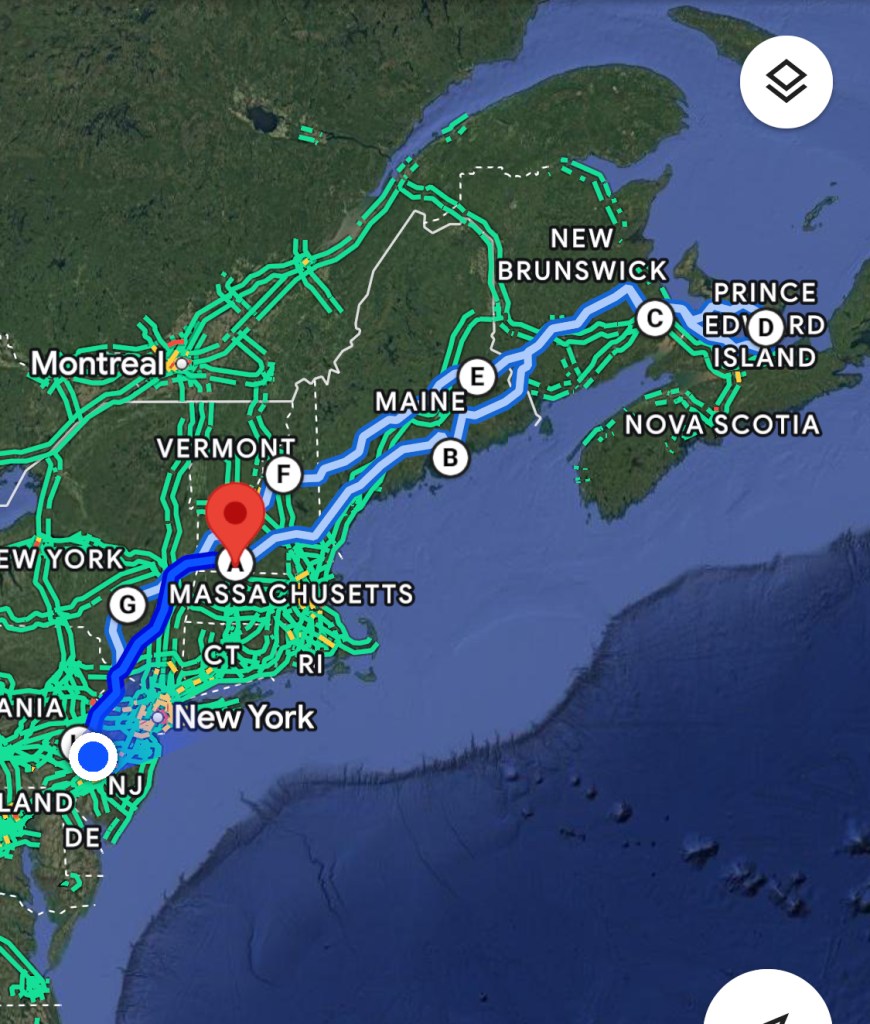
2586 miles in 9 days from Pennsylvania to Prince Edward Island on motorcycles.
No Highways. One toll to leave PEI. Backroads and local spots the entire way. Home-sweet-home while away was a mix of camping, park cabins and old-school motels.
300+ miles and 8+ hours a day on the bikes did not leave much time for exploring along the way. Here are the plants I found on this journey mostly at our overnight stops, discovered during early morning or sunset walks with a hot cup of tea or a local beer, getting some time in to explore, stretch the legs and find all the new-to-me plants and familiar plants in new places I could find before getting back on the seat for another full day’s ride.
THE INSPIRATION
The inspiration for this trip was to see Prince Edward Island and the town of Cavendish, the town the inspired Avonlea, the setting of Anne of Green Gables by LM Montgomery. Due to the nature of long distance travel and limited time frame for this trip I had zero plant-based goals for this trip – no garden visits or hikes planned. My adventure buddy Meghan and I grew up reading and watching and inspired by Anne of Green Gables. 9 year-old me was obsessed with the 1985 pbs series and did not miss an episode. These stories stuck with us into adulthood. The setting of the stories was a bucolic farmstead on Prince Edward Island, based on the town of Cavendish and we decided to make a pilgrimage to see it.
Seeing certain plants in the wild for the first time sticks with me. I learned plants from my jobs working in garden centers in high school and college (does anyone remember Frank’s Nursery and Crafts? This is, incidentally, the first place I ever got high – they had me, freshman college student, glueing PVC pipe together for a greenhouse irrigation system inside the greenhouse for hours, you know that purple primer and the glue, after my shift I had to sit in my car for a while breathing in clean air before I felt like I could drive – that’s what all the fuss is about – getting high? I was not impressed or interested in feeling like that again …anyway back to plants!)
Just as I remember very clearly that glue incident, I remember distinctly where I saw some of my first familiar plants in the wild. My nascent plant education was not through finding plants in the wild and learning what they are, but through working in retail garden centers, answering customers’ questions and unloading, organizing, staging, arranging, watering and maintaining plants in nursery yards. Then I learned my plants in college using our botanical garden campus as a classroom. My early plants were containerized and immature or in an artificial garden setting. Sure I knew some plants from my pine barrens childhood – oaks, pines, blueberries, black walnut, sassafras, sweet fern and bracken fern but the plants I learned as I started my education and career were mostly, in my mind, commodity sized and situated.
As I started exploring more and more, and botanizing became a hobby obsession, I began encountering those plants I used to load into the trunks of Subarus and the beds of pick-up trucks as mature specimens in the wild.
This was magical to me and so educational. Here I could see where they really want to grow, versus where I may or may not have told a customer where they would like to grow. I could see their neighbors, who they want to grow with, what types of plants thrive in similar conditions of soil type, soil moisture, sunlight and exposure.
I distinctly remember the excitement of finding my first, and only to date, wild Oakleaf Hydrangea in a Mississippi forest. My first Sweetspire growing along a tea-colored creek in my beloved Pine Barrens. My first wild Alumroot dripping off a soggy wall in a Pennsylvania preserve. These memories are indelible. (If I meet you and we have met before and it seems I cannot remember your name, please note what my limited memory storage space is filled with) Prior to these encounters, I had only known these plants as inventory.
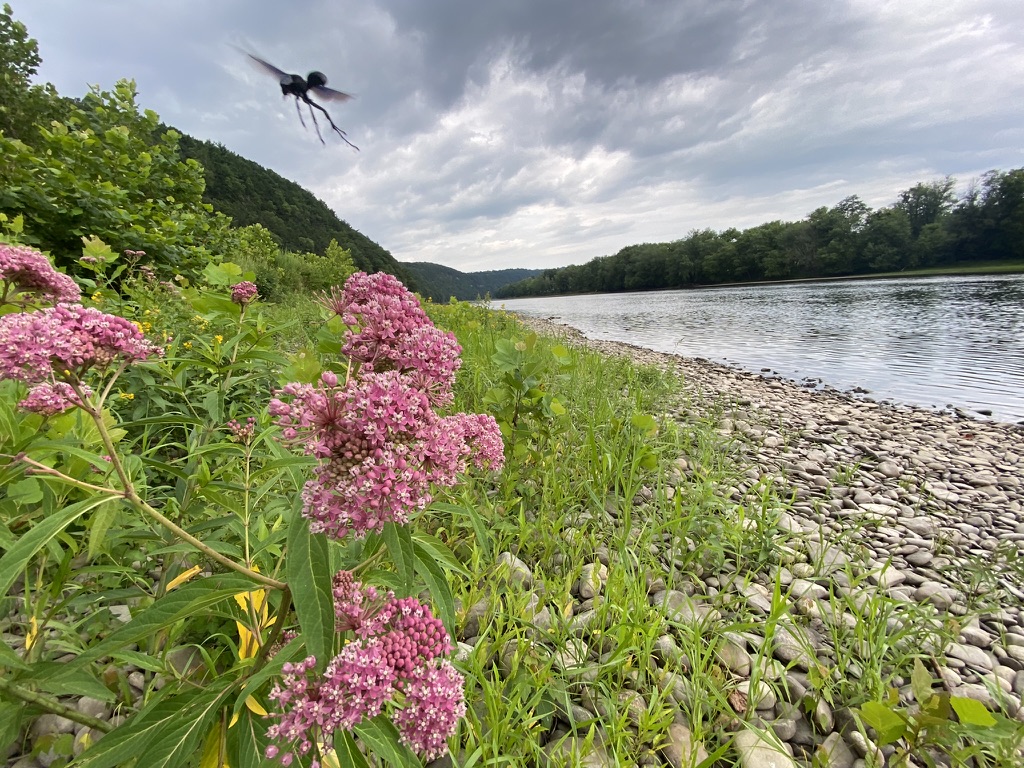
This trip on the Susquehanna added another memory to the list.
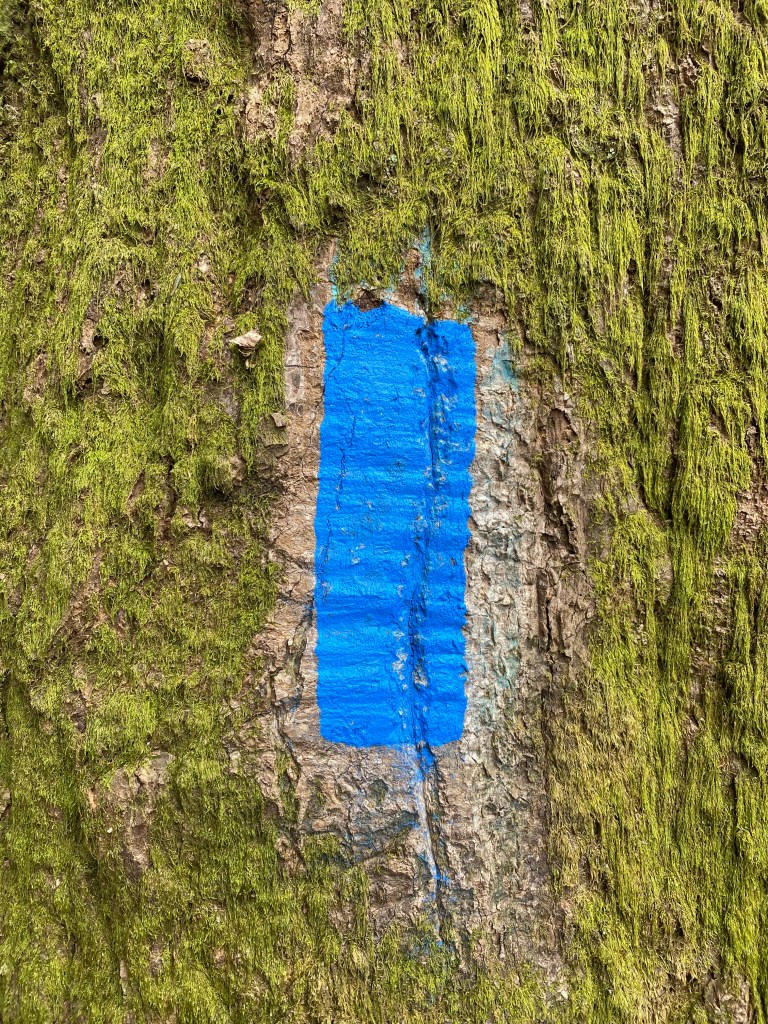
A blue trail blaze within a. coating of moss on a tree marks the way. Susquenhannock State Park, PA
“Directionally challenged” is how I describe myself almost daily. I do not know why my brain doesn’t work that well when it comes to figuring out where I am in relation to where I need to be. I have lived in my home for more than a decade and still have to think very hard about which direction I need to turn out of the driveway to get to the grocery store.
When people give me directions or locations telling me something is North, South, East or West I have no idea what that means in relation to where I am standing, unless the sun is rising or setting. Some people seem to have an innate ability to know where the north side of something is. I cannot tell you, ever.
It is not age, I have been like this my entire life. It has not gotten any better with the invention of google maps. Solo hiking for me is a challenge and often nerve wracking because I am always afraid I will get lost. While I do have the comfort of AllTrails maps and all of the other technology right there in my phone, I still struggle with anxiety when it comes to finding my way around.
I have come to realize the more I practice, the better and more comfortable I become. I know I need landmarks to find my way around and I create those landmarks as I hike, making note of particular points of interest to me as I walk. The sense of pride and accomplishment I feel when I make it back to the car, is worth it, even though I often add a lest a half mile to any hike trying to get better on relying on reason and memory to guide my adventure.
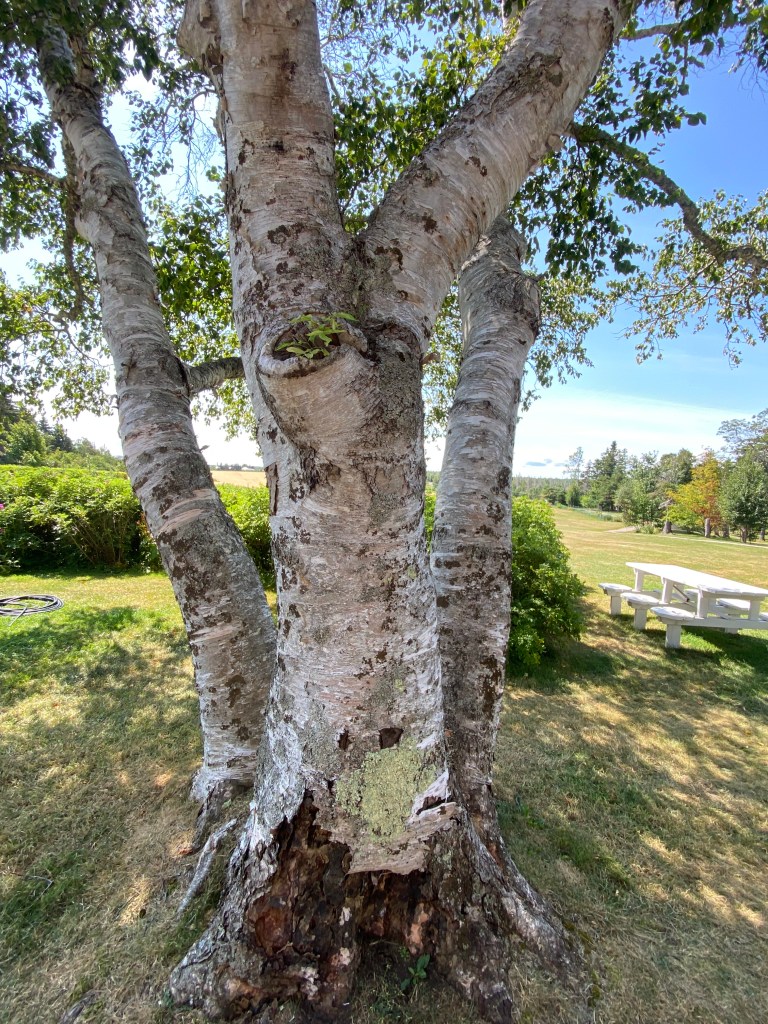
Ailanthus altissima (Tree of Heaven) is a common tree of cities. When I talk to people about it I often mention it is the tree featured in Betty Smith’s A Tree Grows in Brooklyn. People are generally surprised to know this tree, by now a well-known invasive, is the subject of this well-loved book. Tree of heaven is ubiquitous in cities, I first became familiar with its ways in Newark, NJ and then saw it all around Philadelphia when I started working in the area. Found in nearly every vacant lot or fallow area, it is considered invasive and ecologically problematic. It is also the host plant for the troublesome spotted lanternfly. This is the weed tree of the city I am familiar with, this is not, however, the tree pictured above.
“Secrets are generally terrible. Beauty is not hidden, only ugliness and deformity.”
L.M. Montgomery
Damp Rock Wall Along a Hiking Trail Damp Rock Wall Along a Hiking Trail
As I hiked this past Sunday, I was looking very closely at a wall of rocks. I have hiked here before and was on the hunt for spring wildflowers. I remember this wall as one of the first places I have seen Heuchera americana (Coral Bells) growing in the wild.
I do that. I remember the wild places I first saw plants I know well from nurseries and garden centers and gardens. I remember the Pine Barren creek where I first saw Itea virginica (Sweetspire) and the Pine Barrens lake where I saw Sarracenia purpurea (Pitcher Plants) and Drosera sp. (Sundews) growing wild. My first wild PawPaw (Asimina triloba) patch along the Potomac River. I remember my first wild Gentiana andrewsii (Bottle Gentian) viewed from the cockpit of my whitewater boat and my sister’s patience as I delighted in seeing a wild Hydrangea quercifolia(Oakleaf Hydrangea) for the first time in a Mississippi forest. The pine needle strewn forest floor in New England where I saw my first Lady Slipper Orchid (Cypripedium acaule). The place where I first witnessed the majesty of a Sequoia sempervirens (Coast Redwood) is indelibly etched in my mind.
Pink Lady’s Slipper (Cypripedium acaule) in a New Jersey forest.
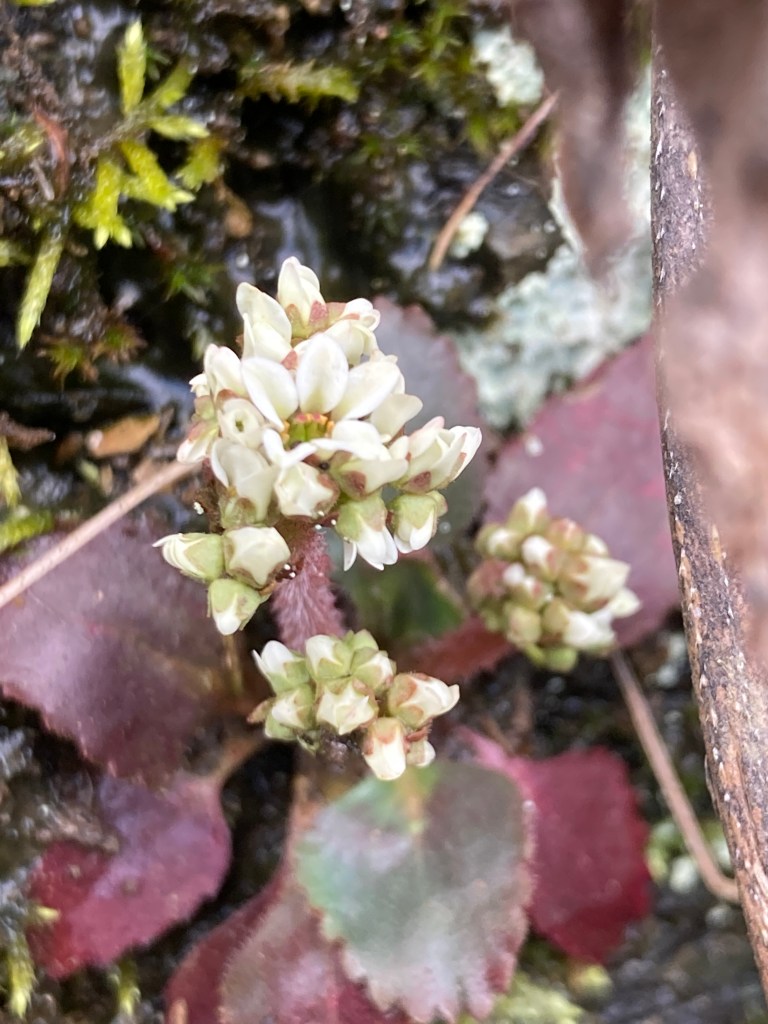
On occasion I get back to these places and revisit those plants. And on this hike I was on the search for my rock-face-hanging Coral Bells. While searching, three types of ferns I saw clinging to this wall, Early Saxifrage ( in bloom, and Columbine leaves with tight buds just above the moss hinting of the red and yellow spectacle to come all came into view. I did find Coral Bells too.
Spleenwort Fern of some kind Walking Fern (Camptosaurus rhizophyllus)Early Saxifrage (Saxifraga virginiensis)Early Saxifrage (Saxifraga virginiensis)Early Saxifrage (Saxifraga virginiensis)
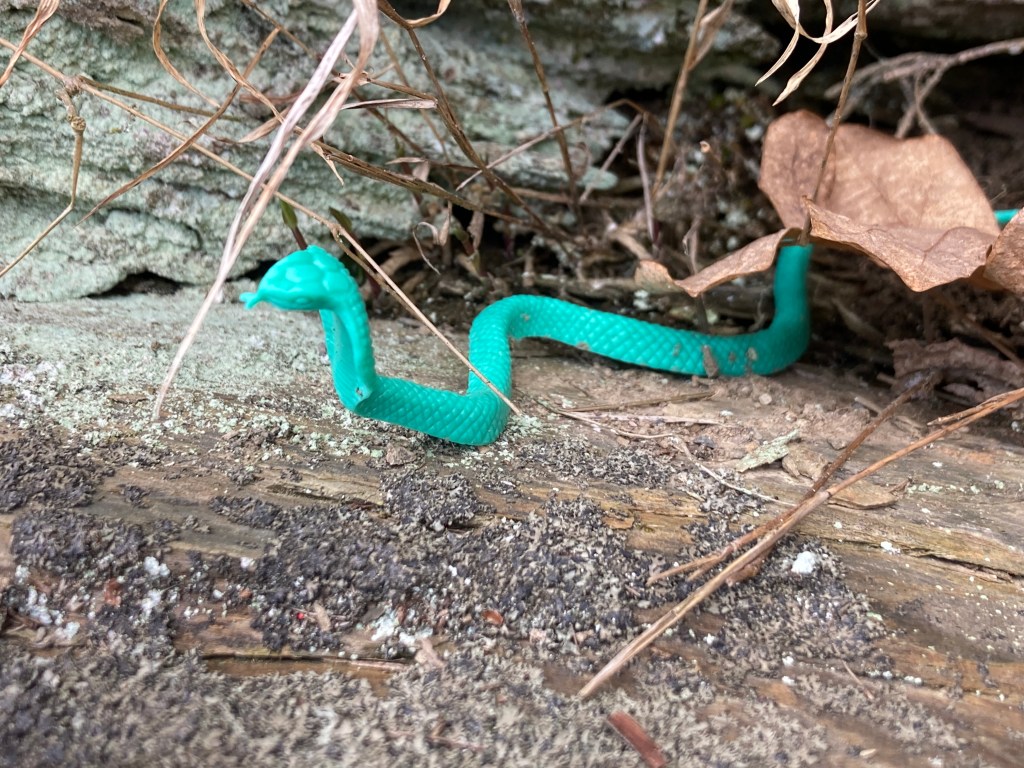
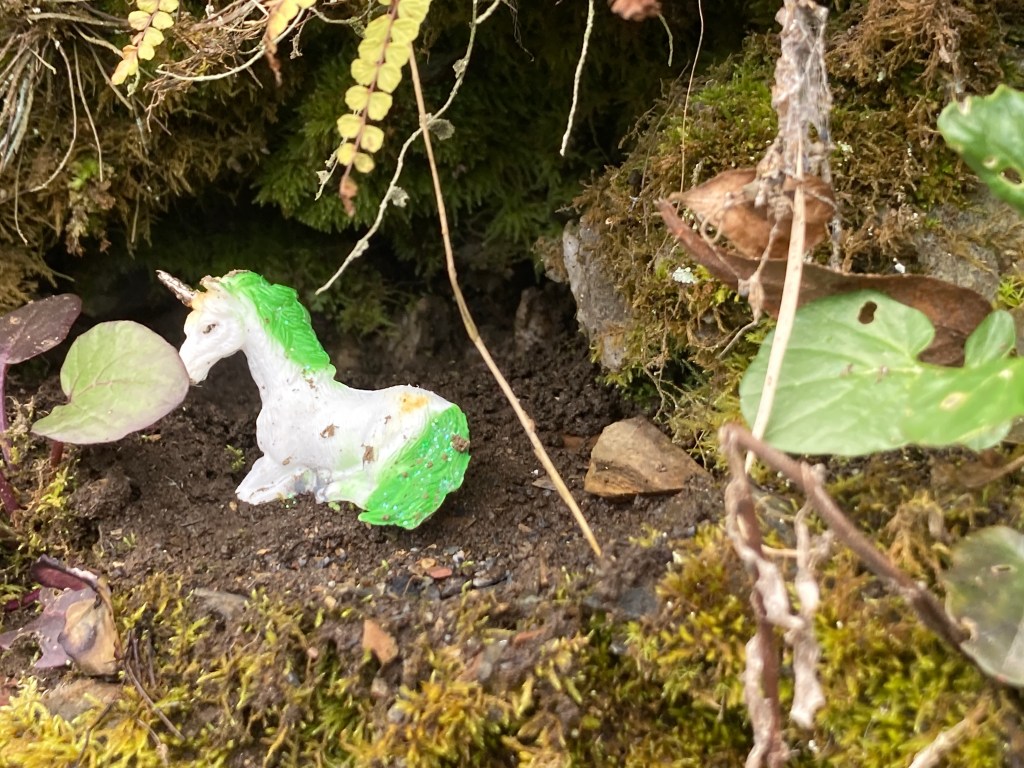
On this day I also noticed some one had tucked little non-natural treasures into the tapestry of moss, roots and leaves. I found a tiny duck, a little bunny, a unicorn and a turquoise snake.
So here I was, nose inches from the wall, investigating these tiny treasures when I hear a woman with a dog behind me. “Excuse me,” she says, “I am nosy. What are you looking at?”
“Plants,” I tell her, “I am a horticulturist.”
“Oh” she says. She goes on to tell me how she grew up in the area and nearly 70 years ago she remembers seeing Jack-in-the-Pulpits (she describes them and asks me if that’s the correct name and I tell her yes) and how she fell in love with them. She was amazed by them and remembers seeing them everywhere, but as she got older, she didn’t see them as much and then they disappeared. Almost 70 years later, she told me, she was hiking back in this same spot and there was a Jack-in-the-Pulpit. She said she was so excited. It brought back so many happy memories of her childhood and she was surprised. It looked like the only one around.
“So I dug it up and took it home.” she shares with me, in a hushed tone that speaks to understanding this was wrong.
As a single person I have been thinking a lot about selection.
When considering another person to share time and space and energy with I have criteria I would like that person to meet. These criteria are different depending on the circumstances – are you going to be a friend… or are you going to be um.. more than a friend? I have a list of “need to haves” and “neat to haves” applying to either scenario.
As a horticulturist I think about selection too.
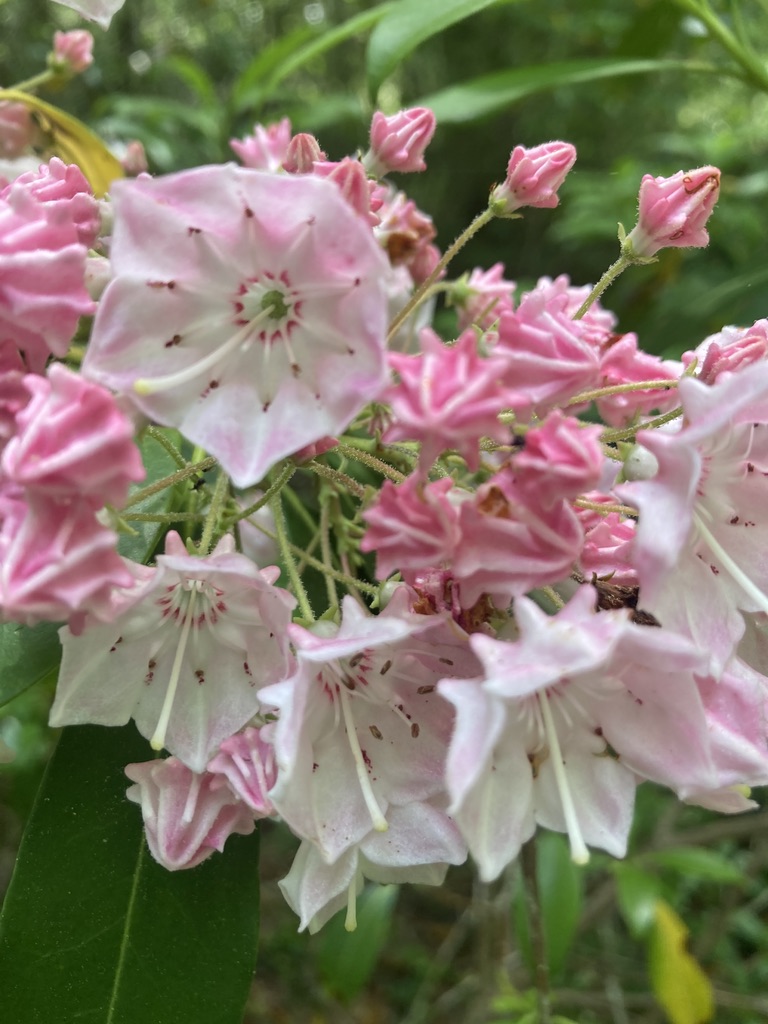
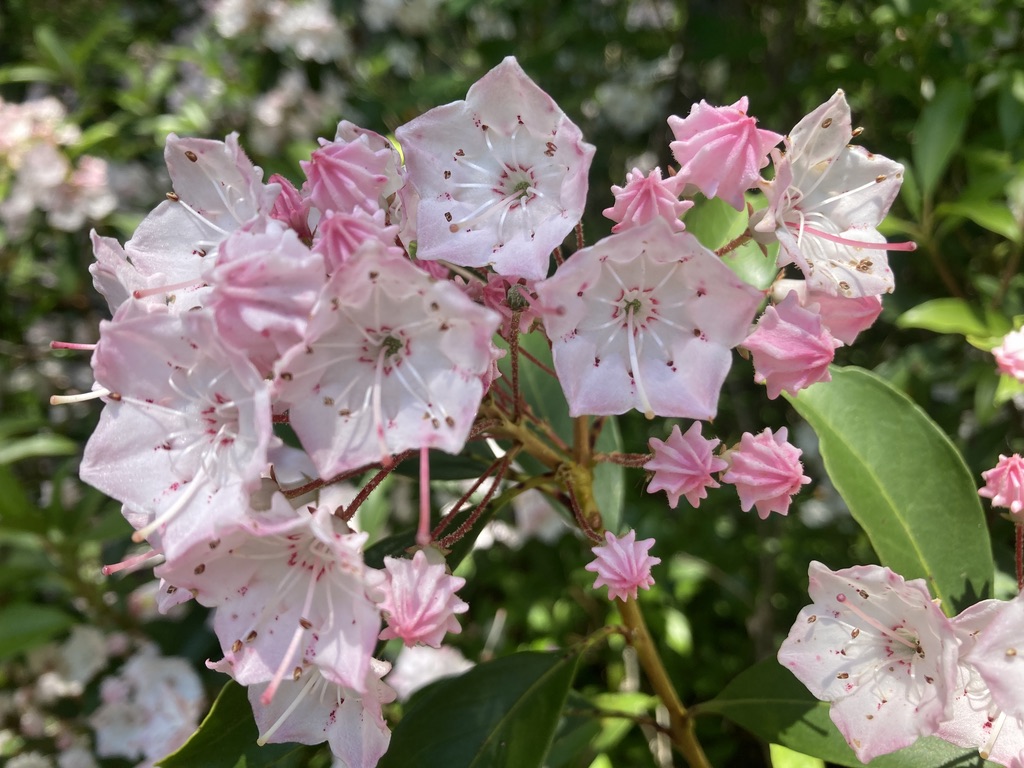
On a recent vacation I just happened to be on the trails at the exact right time to find mountain laurels in full bloom. Though I hike a lot, I often find myself in mountain laurel areas thinking to myself “I have to remember to come back here when these will be in full bloom.” And then not getting back to them until the same time the next year, if at all. So I was thrilled to find myself in multiple places with these beauties in full show.
What really caught my attention as I wandered these trails was the variation in color of the mountain laurel flowers.
Notice, in the photos above, all the color variation of the mountain laurels I found in my recent travels. These are naturally occurring wild species of this plant – Kalmia latifolia. The flowers on different plants ranged from pure white with no sign of pink at all to solid dark pink and every variation in between. A dark pink one could be right next to a pure white one.
A cultivar, or cultivated variety of a plant, is a selection. The characteristics it features were selected by someone who thought they added value to the plant – could be disease resistance, cold hardiness, double flowers, purple foliage, etc. You can tell a cultivar when you are purchasing plants by the name in ‘single quotes’ on the plant name tag. If it has a name in single quotes you have a cultivar on your hands.
A cultivar is different from the straight species of a plant. The straight species is the one that grows in the wild and is only modified by mother nature. Natural variations abound within straight species of plants and this is where a lot of cultivars come from.
This type of genetic variation is where plant selections come from. Plant breeders would take seeds or cuttings of the plants with the interesting and desirable traits and try to create plants that reliably demonstrate these characteristics. Then they give the plant a marketable name and put it out for sale. The dark pink mountain laurels so popular at garden centers are cultivars of these I found in the wild. In fact there are more than 75 cultivars of mountain laurel.
Unlike when we get to choose people, based on our lists of wants and needs and likes and dislikes, for the most part, we are only able to choose plants that have been designed for us. These plants have been chosen for us out of myriad genetic combinations and mutations happening out there in nature based on what marketers think will sell well, what horticulturists find interesting and what problems hybridizers want to solve or niche they want to fill.
I have a goal to hike 250 miles this year. I figured this averages out to about 5 miles per week and that felt like a realistic, yet challenging, goal for me.
As of today I am 127 miles in and have been hiking at least weekly since January.
Hikes serve many purposes in my life: meditation, relaxation, connection, reflection, exploration, and education.
Here I share some of my trail education. I am always looking at the plants along my hikes, naming them if I can, and trying to figure out who they are if I can’t. Some of us call this process botanizing.
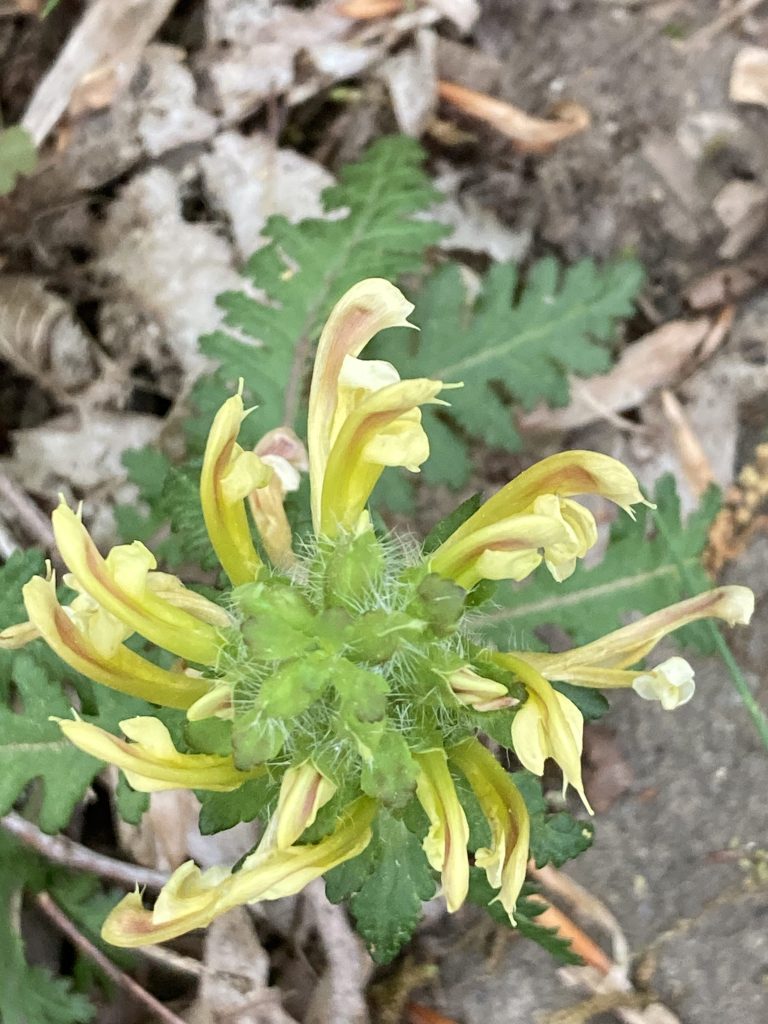
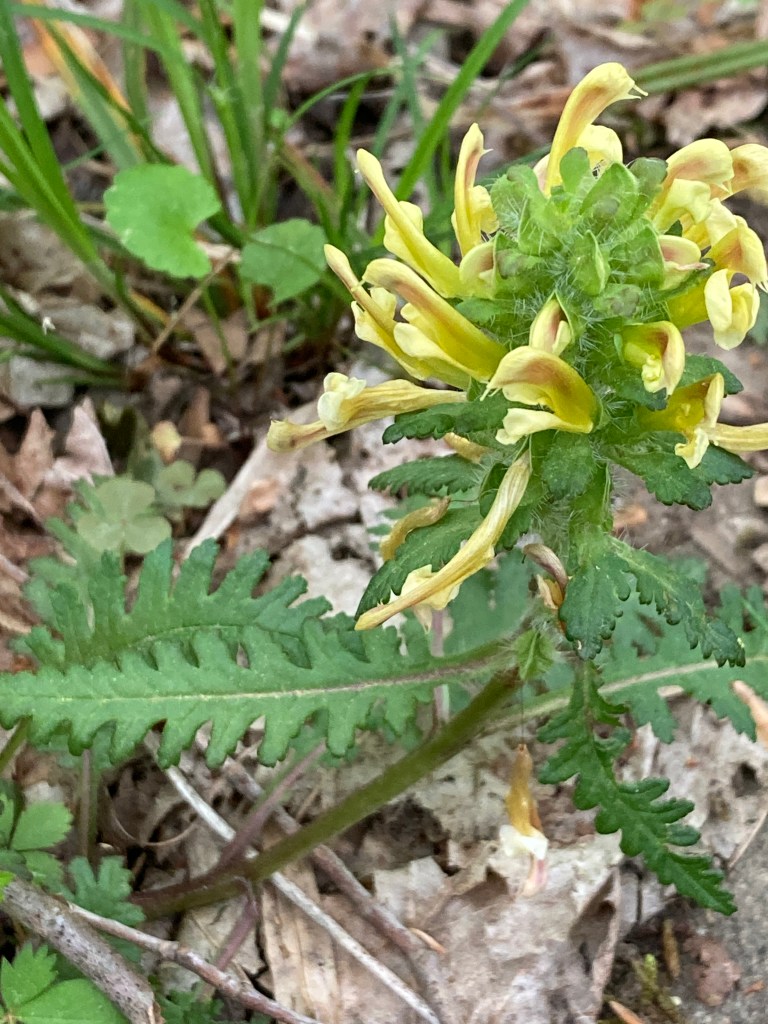
These are new-to-me plants I encountered on some of my hikes this year. Nearly every time I go out on a trail I run into a plant I have never noticed, never learned, or have long forgotten. I don’t typically take a field guide with me on the trail. I take so long taking photos on these hikes already I am afraid adding the potential for dive into a field guide around every bend would keep me from getting very far at all. So my process is to take photos of the new-to-me plant and then figure out who it is when I get home.
The photos I take are of the habitat (where it is growing); the habit (its overall form or shape); the flowers if it is blooming (close ups from top, side, bottom and front , making sure to capture the pistils and/or stamens if present); the leaves (the entire leaf, a close up of the leaf margin, the underside and a close up of the leaf veins); and the stems (focusing on color and hairs, both leaf stems and flower stems); if it is a woody plant I will also take photos of the bark and the twigs (including leaf scars).
I then come home and consult a field guide depending on the type of plant. I know there are apps for this. But I like this process of documenting the details and then when I get home from a hike diving into these details and solving my personal mystery using a book, with pages and an index. I find when I do this, these plants stick with me and I remember them forever.
Of course, this is not a fool-proof system and sometimes I need to revisit the plant (aw shucks… another hike) to gather intel on some teeny tiny detail that separates one species from another.
Here are a few of the new-to-me plants I did figure out and will now know forever:
On a recent hike on the anniversary of a day significant to me for the trauma I experienced on that day I was thinking a lot about scars.
5 years ago, to the day on this day of my hike, I learned that you can feel your heart break. This may sound insane to some people and lucky you for not knowing or not having had the experience. Those of us who have experienced this we know it certainly is a thing. And while I do not know if my heart looks any different from when it did before that moment (I suspect not, but still I wonder), I feel like there is a scar there along the place where it broke. My heart physically feels like it changed forever, but I know it continues functioning and supporting me, still able to love, forgive and care and still moving blood and oxygen around this body.
I noticed, like us, they have scars for two types of wounds – the intentional and the accidental. Like us, regardless of how the wound got there, the tissue created to protect and heal the wound is the same.
Callous can describe a person. It certainly can describe the person who caused this heartbreak. This usually means they are insensitive or unfazed by emotions, empathy or sentiment. I think of it as meaning that they are hardened from these emotions, perhaps because of something that happened to them, perhaps because they never witnessed those emotions in action or felt those emotions personally, who knows.
Completely healed tree wound
Completely healed tree wound
Callousness can be a protection from getting too close, from feeling emotions.
A callous can also be a protection. You may know the raised, hardened bumps of skin on palms and fingers that speak to the work you do and the hobbies you have. I have callouses from splitting firewood, from raking leaves, from shoveling snow, from gardening and from kayaking. These callouses form over time after repeated damage or irritation to protect the skin in the future.
Though spelled differently, callus wood forms on trees as protection.
Compartmentalization of decay in a tree
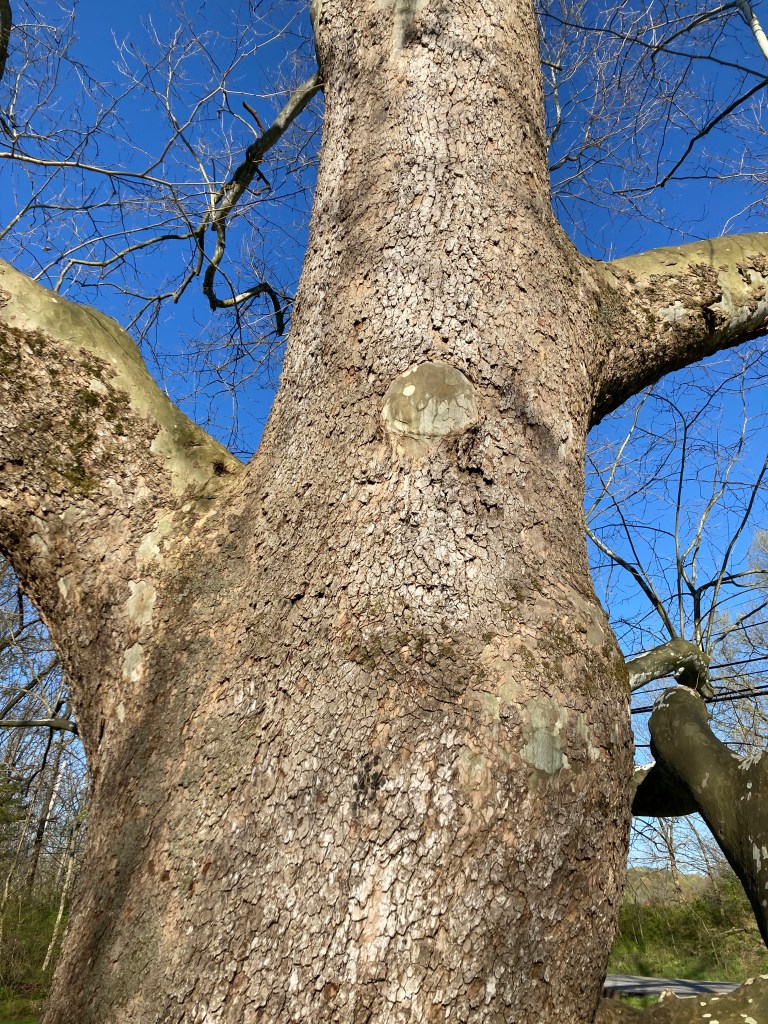
Trees naturally compartmentalize damage to prevent it from spreading to the rest of the tree. Part of this process is the creation of callus tissue, the process of which begins the moment the tree is damaged. These undifferentiated cells, called parenchyma cells, grow quickly and spread to cover the wound before insects or diseases can enter. These are also the cells that create burls on trees. Eventually as these cells grow, woundwood forms and covers the wound like a scab covers and protects the wound.
Large sycamore (Platanus occidentalis) with completely healed wound
The difference between the woundwood and surrounding tissue is evident on this healed wound
We can think of callus wood on a tree like scar tissue, a different, smoother type of tissue than the surrounding tissue. Like scar tissue which is stronger because the arrangement of cells is more dense and arranged in a way that makes it strong but less flexible.
When a surgeon operates on us, the cuts are intentional and created to heal as well and as fast as possible with little scarring and complete healing. When our wounds result from unintentional accidents or are the result of the callousness of another human the scarring may be worse, the wound longer to heal and in some cases may not heal at all.
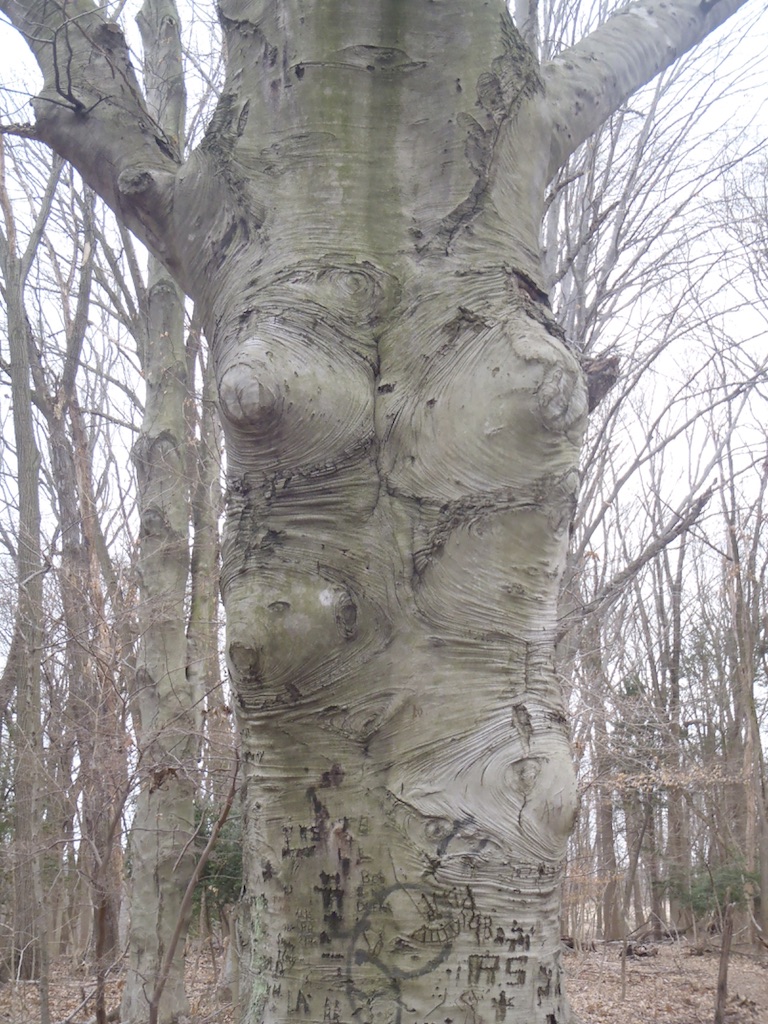
Many completely healed wounds on this American Beech.
The same is true of trees, when storms damage trees the callus and woundwoond may not be able to form, leaving the tree susceptible to further damage. If a well trained and knowledgeable arborist is pruning a tree, they know to cut properly so the wound can heal completely.
I suppose when our hearts break there is no way to know if we heal completely. I like to think that my heart has healed completely. While I do not know if there is physical evidence of the damage, I know I will never forget the feeling, and I am certain it is vulnerable to being broken again, but it is stronger and different and functioning just fine, despite the damage.
Wounds are an inevitable part of a tree’s life, just as they are an inevitable part of ours. How we, and they, heal from them depends as much on the circumstances that created them as the tools within to heal.
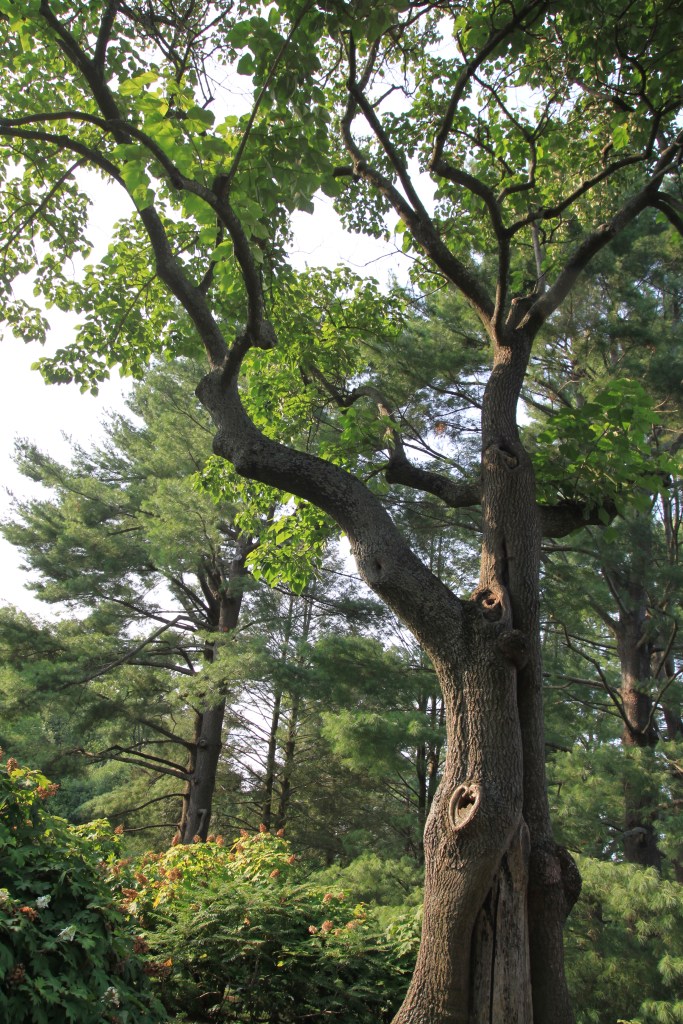
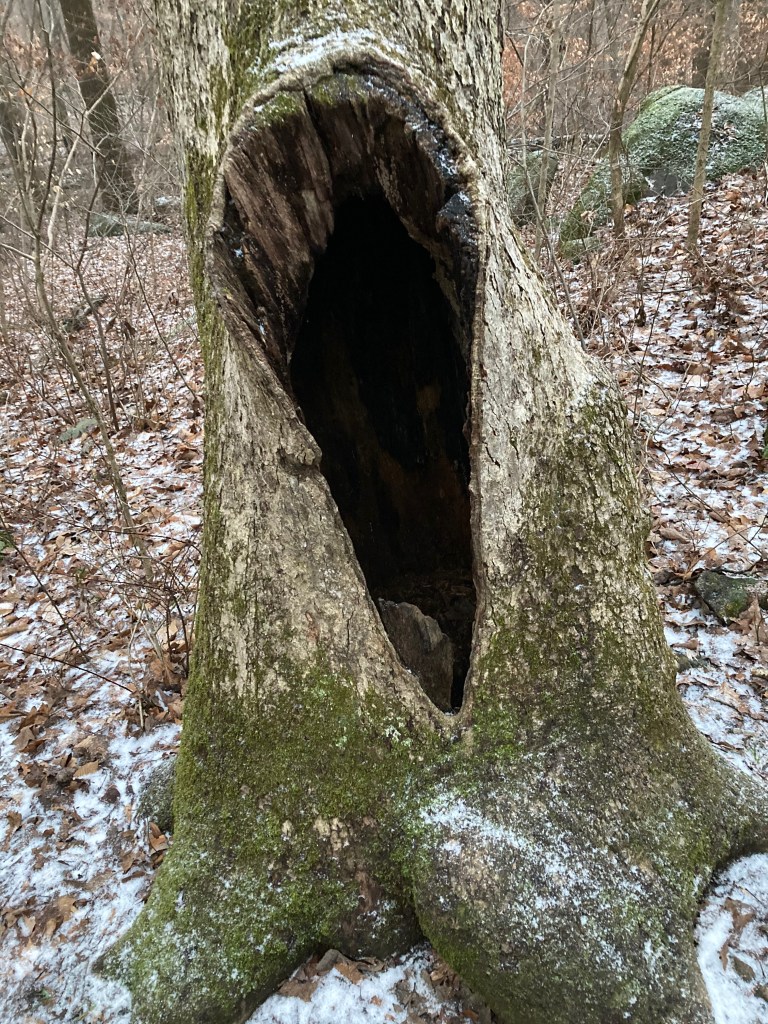
Lots of scars and even a heart-shaped wound, but this tree survives.
Surprisingly, when you look into the crown of this tree, it is perfectly alive.
To describe a feeling of just not caring any more, or as sometimes it’s stated, running clean out of fucks to give, someone may describe themselves as dead inside.
Someone who is dead inside is completing the basic life functions – eating, breathing – but cannot muster caring, empathy, compassion, drive, pleasure, excitement, creativity, appreciation, lust, love.
Spending 2 full days watching the E! Sex and the City Marathon has me reading the title above in Carrie Bradshaw’s voice and imagining it being typed across a pixelated computer screen. Not that Sex and the City ever focused on nature or that Carrie Bradshaw would be caught dead in hiking boots. But thinking about the duplicity of something in a particular circumstance certainly was Carrie Bradshaw’s forte. This binging happened to coincide with the 10th anniversary of me moving into my home sweet home.
Roots and the Reservoir
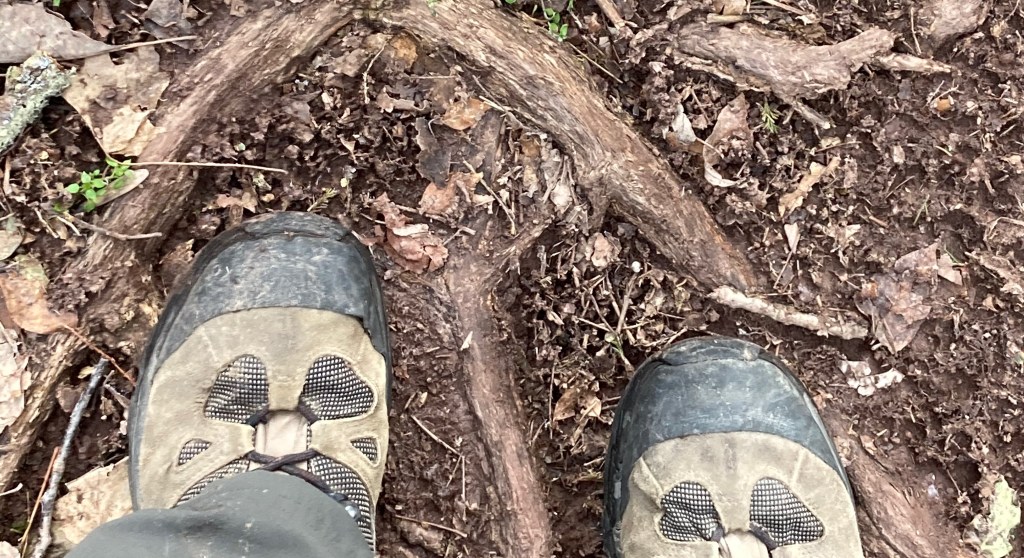
This anniversary of setting down roots, my surprise at being in one place this long and recent reflections on impermanence had me thinking differently about the roots I encountered on a recent hike in Maryland and along a trail I was walking for my annual participation in the first day hike. Really I cannot think of one trail I have hiked that didn’t have exposed roots along the way.
















 HORT travels